

At a glance

Alkoxylates

Wetting, detergency, emulsification

Ionic type
Nonionic
Typical HLB
2–18 (by EO/PO moles)
Foam
Low to moderate
Key industries
Home care, Agro, Textile, Paint

Biodegradability: Linear alcohol ethoxylates are typically readily biodegradable; branching and APEO grades need a separate story.
Chemistries

Alkoxylates

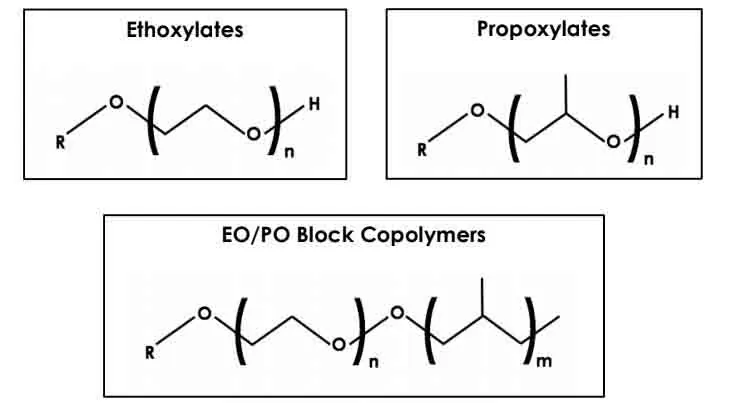
Alkoxylates chemical structure and ethoxylation process diagram - Esteem Industries

Alkoxylates are those chemicals that are produced by addition of ethylene oxide CAS 75-21-8, Propylene Oxide CAS 75-56-9 and butylene oxide to fatty hydrophobes via alkoxylation process. We manufacture various types of fatty alcohol alkoxylates, fatty acid alkoxylates and fatty amine alkoxylates which are used as wetting agents, cleaning agents, emulsifying agents, detergents, and stabilizers etc. These surface-active compounds and alkoxylated surfactants are biodegradable and therefore environment-friendly in nature. Our ethoxylation and propoxylation processes produce EO/PO block copolymers and specialty alkoxylated products.

Alkoxylates find extensive applications across multiple industries. In personal care, they serve as emulsifiers and conditioners. In home care, they are essential for laundry and cleaning surfactants. Textile applications utilize alkoxylates as dyeing auxiliaries and finishing agents. Paper manufacturing relies on alkoxylates for defoamers and dispersing agents. Paint & coating industries use them for emulsion polymerization. Agriculture applications include neem oil emulsifiers. We also offer specialty alkoxylates including narrow range ethoxylates and methyl ester ethoxylates.

We also manufacture various alkoxylates products according to our customer's requirements or specifications on cloud point, hydroxyl value, sap value, pH, HLB (hydrophilic lipophilic balance) etc. Explore our custom synthesis services for tailored alkoxylate solutions.

Product range

Alkoxylate families we manufacture

Natural Oil Ethoxylates
Product EO Moles
Castor Oil 5-200 EO Moles
Hydrogenated Castor Oil 10-100 EO Moles
Neem Oil 10-30 EO Moles
Soya Oil 3-10 EO Moles
Linseed Oil 3-10 EO Moles
Lanolin Oil 75 EO Moles
Fatty Acid Ethoxylates
Product EO Moles
Oleic Acid 2.5-15 EO Moles
Stearic Acid 8-70 EO Moles
Coconut fatty Acid 10-12 EO Moles
Rice Barn Fatty Acid 5 EO Moles
Fatty Amine Ethoxylates
Stearyl Amine 10-30 EO Moles
Tallow Amine and Tallow Diamine 3-20 EO Moles
Coco Amine 10-30 EO Moles
Oleyl Amine 15-30 EO Moles
Amoino Propyl Behnyl Amine 10-90 EO Moles
Ethylene Diamine 4 EO Moles
TEA Ethoxylates 100 EO Moles
Alkyl Phenol Ethoxylates
Nonyl Phenol 4.5-100 EO Moles
Octyl Phenol 1-70 EO Moles
Dodecyl Phenol 5-20 EO Moles
Styrenated Phenol 18-25 EO Moles
Phenoxyethanol 99.5%
Phenol 4-20 EO Moles
Fatty Alcohol Ethoxylates
Oleyl Cetyl Alcohol: C16-18 (unsaturated) 2-60 EO Moles
Oleyl Alcohol: C18 (unsaturated) 5-60 EO Moles
Tri Decyl Alcohol: C13 (branched) 3-100 EO Moles
Decyl Alcohol: C10 (linear) 4-10 EO Moles
Ceto Stearyl Alcohol: C16-18 2.5-80 EO Moles
auryl Alcohol: C12-14 2.5-25 EO Moles
Behnyl Alcohol: C18-22 5-40 EO Moles
Stearyl Alcohol: C8 2-15 EO Moles
2-Ethyl Hexanol: C8 (branched) 2.5-4.5 EO Moles
2-Propyl Heptanol: C10 (branched) X EO Moles
Octyl Decyl (C8/C10) Alcohol 2-10 EO Moles
C12-15 alcohol 2.5-20 EO Moles
C8-10 alcohol 2.5-20 EO Moles
C12-13 alcohol 2.5-20 EO Moles
C11 alcohol 2.5-20 EO Moles
Trimethalol Propane 4.5 EO Moles
C9-11 alcohol 2.5-20 EO Moles
Polysorbates
Polysorbate 20 (Sorbitan Mono Laurate 20 EO)
Polysorbate 40 (Sorbitan Mono Palmitate 20 EO)
Polysorbate 60 (Sorbitan Mono Stearate 20 EO)
Polysorbate 65 (Mono Tri Stearate 20 EO)
Polysorbate 80 (Sorbitan Mono Oleate 20 EO)
Polysorbate 81 (Sorbitan Mono Oleate 5 EO)
Polysorbate 85 (Sorbitan Tri Oleate 20 EO)
EO-PO Copolymers
EO-PO (30) Polymer 2-60 EO Moles
EO-PO (30) Polymer 5-60 EO Moles
EO-PO (30) Polymer 3-100 EO Moles
EO-PO (39) Polymer 4-10 EO Moles
EO-PO (39) Polymer 2.5-80 EO Moles
EO-PO (56) Polymer 2.5-25 EO Moles
EO-PO (30) Polymer 5-40 EO Moles
EO-PO Polymer 2-15 EO Moles
EO-PO Polymer 2.5-4.5 EO Moles
EO-PO Polymer X EO Moles
EO-PO Polymer 2-10 EO Moles
EO-PO Polymer 2.5-20 EO Moles
EO-PO Polymer 4.5 EO Moles
EO-PO Polymer 2.5-20 EO Moles
EO-PO Polymer (reverse) 2-60 EO Moles
EO-PO Polymer (reverse) 5-60 EO Moles
EO-PO Polymer (reverse) 3-100 EO Moles
EO-PO Polymer (reverse) 4-10 EO Moles
MPEGs
Methoxy PEG 400-5000 Mol. Wt.
APEGs
Allyl PEG Upto 5000 Mol. Wt.
PEGs
Polyethylene Glycols (PEGs) 200, 400, 600, 800, 1500, 4000, 6000, 8000, 12000, 20000 Mol. Wt.
EO-PO Surfactants
2-Propyl Heptanol EO/PO
Tridecyl Alcohol EO/PO
Lauryl Alcohol EO/PO
Decyl Allcohol EO/PO
Oleyl Cetyl Alcohol EO/PO
Oleyl Alcohol EO/PO
Stearyl Alcohol EO/PO
Butanol EO/PO Copolymer (R) Mol. WT. 1450
Butanol EO/PO Copolymer (R) Mol. Wt. 1650
Bisphenol A 2 Mole PO
Castor Oil EO/PO
Nonyl Phenol EO/PO
Ethylene Diamine 4 PO, 4 EO
End-Capped
C9-11 Alkoxylated benzyl capped 10-12 EO
C8-10 Alkoxylated benzyl capped 10-12 EO
Polyglycerates
Polyglycerates
Product EO Moles
Polyethylene Glycerol Mono Oleate 200-600 Mole EO
Polyethylene Glycerol Di Oleate 200-600 Mole EO
Polyethylene Glycerol Mono Stearate 200-600 Mole EO
Polyethylene Glycerol Di Stearate 200-600 Mole EO
Special Ethoxylates
N,N-Bis(Hydroxyethyl) Aniline
Nonyl Phenol Resin Ethoxylates X Mole EO
Styrenated Phenol Ethoxylates X Mole EO
Alkanolamide Ethoxylates CMEA-3/5EO
Actylinic Diol Ethoxylates (Venadol series) TMDD-20,40,65,85
Salt-free Alkoxylates Na / K <  10ppm
Methyl ester Ethoxylates
Acetylinic Diol blends (Venadol series)
Narrow Range Ethoxylates
Product Hydrophobe Moles EO Appearance at 25°C Comments
T-DET A 26-4.5 NR C12-16 4.5 Hazy Liquid Available from natural hydrophobe
T-DET A 267 NR C12-16 7 Hazy Liquid Available from natural hydrophobe
ME 400 CO Coconut Methyl Ester 9 Hazy Liquid Available from natural hydrophobe
ME 500 SO Soya Methyl Ester 9-12 Hazy Liquid Available from natural hydrophobe
Selection guide

Alkoxylate family selection (typical starting grades)

C12–15 / C12–14, 3–9 EO

Fatty alcohol ethoxylates

Detergency, wetting, EC emulsification

FAE guide
Coco / tallow, 2–15 EO

Fatty amine ethoxylates

Corrosion, agro, oilfield

Amine EO guide
25–40 EO

Castor / natural oil ethoxylates

Solubilizers, textile, agro EC

Castor EO
L / F / R types

EO/PO copolymers

Low foam, metal, oilfield

EO/PO guide
C12–16, 4.5–7 EO

Narrow-range ethoxylates

Low 1,4-dioxane narratives

NRE products
FAQ

Frequently Asked Questions - Alkoxylates

Find answers to common questions about alkoxylates

Alkoxylates are a class of specialty chemicals produced through alkoxylation processes, including ethoxylation (addition of ethylene oxide) and propoxylation (addition of propylene oxide). They are the foundation of many nonionic surfactants and are used across multiple industries.
We manufacture a wide range of alkoxylates including fatty alcohol ethoxylates, fatty acid ethoxylates, fatty amine ethoxylates, natural oil ethoxylates, EO-PO copolymers, and narrow range ethoxylates.
Ethoxylation involves adding ethylene oxide (EO) units to create water-soluble, hydrophilic products. Propoxylation involves adding propylene oxide (PO) units to create more hydrophobic products. EO-PO copolymers combine both for balanced properties. The ratio and sequence determine the final product characteristics.
Alkoxylates are used in home care, personal care, textile, agriculture, oil & gas, and paint & coating industries. They serve as emulsifiers, wetting agents, detergents, and dispersants.
Lower EO (2–3) stays oil-soluble and acts as a co-emulsifier; mid EO (5–9) is the detergency/wetting workhorse; higher EO (12–20+) raises HLB for solubilizing. Match the required HLB of the oil and confirm cloud point in your electrolyte. See the fatty alcohol ethoxylates guide.
Yes. We routinely make-to-spec on cloud point, hydroxyl value, sap value, pH and HLB via custom synthesis and tolling. Share the target hydrophobe, EO/PO moles, and COA limits with our technical team.
Next step

Need a sample or formulation support?

Talk to Esteem Industries formulators about grade selection, HLB matching, custom ethoxylation, and application trials. Request a sample or technical discussion for your next project.