

Shampoo / body wash
Salt curve, mildness
Shampoo guidePrimary detergency and foam
Biodegradability: SLES/SLS and sulfosuccinates are widely accepted in detergent OECD screens; confirm dioxane on ethoxylated sulfates.
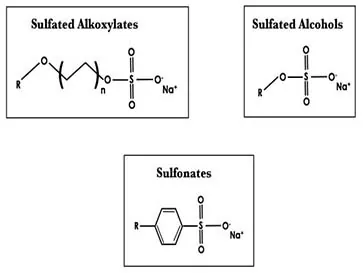
Sulfated fatty alcohols are produced by ethoxylation and sulfation (or sulfonation) of fatty alcohols derived from natural sources such as palm kernel oil, coconut oil, rapeseed oil, and castor oil, as well as from selected synthetic alcohols. As anionic surfactants, they sit at the heart of many cleaning and emulsion systems—see also what makes a surfactant and how amphiphilic molecules reduce surface tension.
Sulfated fatty alcohols deliver emulsifying, wetting, lime-soap dispersing, and foaming performance with useful electrolyte tolerance. Alkyl ether sulfates (ethoxylated alcohol sulfates) improve water solubility and hard-water resistance versus non-ethoxylated alkyl sulfates. These anionic surface-active agents are widely used in emulsion polymerization, cosmetic and personal-care formulations, detergents, textiles, and industrial process aids.
Esteem Industries offers sulfates based on natural and synthetic alcohols and alkoxylates. One of our seven plants has an exclusive facility for sulfonation using oleum and other sulfating agents. Our specialty chemical formulations and industrial surfactants support applications from home care to coatings and polymer latex production.
We also offer phenol and naphthalene sulfonates for leather processing and related industrial uses, alongside sulfosuccinate chemistries centered on Dioctyl Sodium Sulfosuccinate (DOSS) for wetting-critical formulations.
Sulfate surfactants are formed when a hydrophobe—typically a fatty alcohol or an alcohol ethoxylate—is reacted with a sulfating agent so that a sulfate ester group (–OSO3−) becomes the anionic hydrophilic head. Common industrial routes use sulfur trioxide (SO3), chlorosulfonic acid, or oleum under tightly controlled temperature and residence time to maximize mono-sulfate yield and minimize color, dioxane (where ethoxylates are involved), and over-sulfation by-products. After sulfation, the acid ester is neutralized—often with sodium, ammonium, or potassium bases—to produce the finished salt form used in detergents, personal care, and industrial recipes.
When the starting material is first ethoxylated, the product becomes an alkyl ether sulfate. The EO chain length modulates solubility, mildness, and foam character: shorter EO averages favor denser foam and stronger grease cutting in many home-care systems, while higher ethoxylation can improve compatibility in hard water and certain emulsion polymer recipes. Branching in the alcohol (for example 2-ethylhexyl) shifts hydrophobe packing and can enhance wetting on low-energy surfaces—useful in coatings and industrial cleaners alongside paint and coating additives.
Esteem’s dedicated sulfonation capability with oleum and related sulfating agents allows production of specialty sulfates of alcohols, ethoxylates, and selected aromatic hydrophobes for customers who need APEO-free options, polymerizable allyl-bearing sulfates, or naphthalene/phenol sulfonates for leather and dispersant duty. Process control around feedstock quality, sulfation stoichiometry, and neutralization is essential so that active content, pH, viscosity, and residual inorganic salt remain within formulation windows.
Formulators select sulfate chemistry based on foam, mildness, electrolyte tolerance, and substrate wetting. The comparison below maps common Esteem sulfate families to where they are most often deployed. For broader anionic performance context, see our anionic surfactants overview; for blend strategies with nonionics that improve soil removal, read how combining anionic and nonionic surfactants improves cleaning formulations.
| Sulfate type | Key performance traits | Typical applications |
|---|---|---|
| Alkyl sulfates (C12–C14 fatty alcohol) | Strong foam, detergency, cost-efficient cleaning | Detergents, industrial cleaners, selected personal-care bases |
| Alkyl ether sulfates (alcohol + EO, then sulfate) | Improved hard-water tolerance, milder feel vs alkyl sulfates | Shampoos, body washes, dishwashing, emulsion polymerization |
| 2-Ethylhexyl sulfate | Rapid wetting, branched hydrophobe packing | Industrial wetting, specialty cleaners, process aids |
| APEO-free alcohol EO sulfates (e.g. C11-7EO, tridecyl-25EO) | Emulsification with regulatory preference for APEO-free | Latex, textile auxiliaries, eco-sensitive industrial formulas |
| Allyl alcohol EO sulfate (ammonium) | Polymerizable unsaturation for reactive systems | Emulsion polymerization, specialty binders |
| Phenol / naphthalene sulfonates (oleum) | Dispersancy, leather process compatibility | Leather chemicals, pigment and solid dispersions |
| Castor oil / EO-PO copolymer sulfates | Bulky hydrophobe, tailored HLB-like balance | Specialty emulsification, industrial formulations |
Both sulfates and sulfosuccinates are anionic, yet their hydrophilic heads and hydrophobe architectures create different use profiles. Sulfates emphasize foam volume and detergency in rinse-off and laundry systems. Sulfosuccinates—especially dialkyl types such as DOSS—excel at dynamic wetting, emulsification at low use levels, and milder skin feel in many leave-on or sensitive rinse-off contexts. Understanding these differences helps formulators decide when to lead with a sulfate primary surfactant and when to specify a sulfosuccinate wetting agent or co-surfactant.
| Property | Sulfates | Sulfosuccinates (e.g. DOSS) |
|---|---|---|
| Anionic head group | Sulfate ester (–OSO3−) | Sulfonate on succinate diester backbone |
| Primary strengths | Foaming, detergency, cost-in-use cleaning | Wetting, spreading, emulsification, mildness |
| Typical foam | High, dense foam in many rinse-off systems | Moderate; often used where wetting matters more than foam |
| Hard-water sensitivity | Alkyl sulfates more sensitive; ether sulfates better | Generally good performance as wetting/emulsifying aids |
| Personal care role | Primary cleanser (SLS/SLES-type chemistries) | Mild cleanser, co-surfactant, wetting in specialty products |
| Industrial / polymer role | Emulsifier and stabilizer in selected latexes | Preferred wetting agent in emulsion polymerization and coatings |
| Esteem focus grades | Specialty alcohol, EO, and APEO-free sulfates | DOSS 70 / 75 / E / PG and custom sulfosuccinates |
In practice, many high-performance cleaners and latex recipes use both classes: a sulfate or ether sulfate for detergency and particle stabilization, and a sulfosuccinate such as DOSS for fast substrate wetting or monomer droplet emulsification. That complementary approach mirrors the broader principle of balancing anionic power with nonionic compatibility described in our anionic–nonionic blend article.
Dioctyl Sodium Sulfosuccinate (DOSS) CAS 577-11-7—also called docusate sodium or sodium dioctyl sulfosuccinate—is a 2-ethylhexyl diester of succinic acid bearing a sulfonic acid group as the sodium salt. It has a molecular weight of approximately 444.6 and molecular formula C20H37NaO7S. Docusate sodium appears on the WHO list of essential medicines and is used orally as an emollient laxative with stool-softening activity. It is also used as a food additive for emulsifying and humectant activity and in cosmetics. Its effective wetting property drives industrial use in adhesives and sealants; cleaning and furnishing care products (fabric, textile, and leather); ink, toner, and colorant products (pigment dispersion); laundry and dishwashing products; lubricants and greases; and paints, coatings, and paper products. In aqueous systems it can generate foam and promote water spreading that aids fire-control formulations. It has been generally recognized as safe (GRAS) for use in carbonated and non-carbonated beverages as a wetting agent or solubilizer for flavor emulsion stabilizers at levels up to 10 ppm.
Historically, dioctyl sulfosuccinate chemistry has also been used in oil-spill dispersant formulations because of its ability to lower interfacial tension and increase the surface area of oil droplets available for biodegradation. Esteem manufactures industrial DOSS grades for wetting, emulsification, and polymer applications—not pharmaceutical or food-grade claims beyond the chemical identity context above—so customers should match grade, purity, and regulatory documentation to their end use.
Like other surfactants, DOSS is amphiphilic: branched 2-ethylhexyl chains provide hydrophobicity while the sulfonate-bearing succinate core provides a compact, strongly hydrophilic head. At air–water and oil–water interfaces, DOSS adsorbs rapidly, reducing surface and interfacial tension. The branched dialkyl structure packs efficiently at interfaces and often delivers very low dynamic surface tension—valuable when liquids must wet hydrophobic pigments, low-energy plastics, or incompletely cleaned substrates before film formation or polymerization begins.
Above the critical micelle concentration (CMC), DOSS micelles can solubilize oily soils and stabilize monomer or oil droplets. In emulsion polymerization, excess sulfosuccinate helps form monomer-swollen micelles that serve as primary loci for radical polymerization when water-soluble initiators are used. In coatings and pigment pastes, the same interfacial activity improves grind wetting and reduces flocculation risk. Formulators typically dose DOSS at low active levels relative to primary emulsifiers, then adjust for foam, viscosity, and compatibility with electrolytes or co-solvents.
Esteem Industries manufactures Dioctyl Sodium Sulfosuccinate in multiple grades so formulators can match active content and carrier to process constraints:
All DOSS grades offer excellent wetting, dispersing, emulsifying, and foaming properties. Contact us for technical specifications and samples of DOSS 70, DOSS 75, DOSS 70 E, DOSS 70 PG, DOSS 75 E, or DOSS 75 PG.
Use the table below as a practical starting point when selecting among Esteem DOSS grades. Final choice should also consider flash point of ethanol carriers, freeze–thaw of aqueous grades, viscosity at use temperature, and regulatory constraints for the finished good (personal care versus industrial).
| Grade | Approx. active | Carrier | Best suited for |
|---|---|---|---|
| DOSS 70 | ~70% | Water / aqueous | Water-based cleaners, latex wetting, general industrial O/W systems |
| DOSS 75 | ~75% | Water / aqueous (higher solids) | Formulas needing higher active with less water dilution |
| DOSS 70 E | ~70% | Ethanol (E) | Solvent-borne coatings aids, aerosols, systems tolerant of alcohol |
| DOSS 75 E | ~75% | Ethanol (E) | High-active solvent systems where ethanol is already present |
| DOSS 70 PG | ~70% | Propylene glycol (PG) | Low-VOC, pourable specialty and personal care formulations |
| DOSS 75 PG | ~75% | Propylene glycol (PG) | High-active, low-VOC demand with PG compatibility |
Selection tips: Prefer aqueous DOSS 70/75 when the continuous phase is water and VOC must stay minimal. Choose E grades when ethanol improves solubility or drying in solvent systems—verify flammability and packaging. Choose PG grades when you need a pourable, lower-VOC organic carrier that aligns with many cosmetic and specialty industrial bases. If particle size, foam, or coagulum issues appear in emulsion polymerization, adjust DOSS active level before changing primary emulsifier package.
Industrial synthesis of DOSS typically involves reaction of 2-ethylhexanol with maleic anhydride to form the diester, followed by addition of sodium bisulfite across the double bond to install the sulfonate. An alternative path starts from sulfosuccinic acid chemistry with subsequent esterification. Both routes are well established in the patent and scientific literature (for example early esterification/sulfonation patents and later colloid studies on related sulfosuccinate structures). Mixed and ethoxylated monoalkyl sulfosuccinates have also been prepared for research and specialty surfactant programs—for instance ethoxylated sodium monoalkyl sulfosuccinate esters made by reacting selected alcohols, purifying intermediates, and further reacting with polyethylene glycol segments.
At commercial scale, Esteem focuses on consistent active content, color, and residual materials appropriate to industrial wetting and emulsion applications, with the ability to deliver DOSS in water, ethanol, or propylene glycol carriers as listed above.
Emulsion polymerization is a radical polymerization that typically begins with water, monomer, and surfactant—DOSS being a classic wetting and micellar aid. Oil-in-water (O/W) emulsion polymerization is most common: monomer droplets are emulsified in a continuous aqueous phase. Excess surfactant forms micelles; monomer diffuses through water into those micelles; a water-soluble initiator generates radicals that enter micelles and grow polymer particles. The large total surface area of micelles versus large monomer droplets favors particle nucleation in the micellar phase when surfactant and initiator levels are balanced correctly.
DOSS contributes by lowering interfacial tension so monomers emulsify readily, by stabilizing early particles against coalescence, and by improving wetting of hydrophobic monomers or seed particles. Compared with some sulfate primary emulsifiers, dialkyl sulfosuccinates are often valued when formulators need strong dynamic wetting at modest active levels. In acrylic, styrene-acrylic, vinyl acetate, and related systems, DOSS may be used alone in specialty recipes or—more often—as a co-surfactant with alkyl ether sulfates or nonionics to tune particle size distribution, coagulum, and film wetting of the finished latex.
Beyond commodity latex, bis(2-ethylhexyl) sulfosuccinate sodium salt is used in research as a dopant and hydrophobizing agent in the oxidative polymerization of pyrrole, where polypyrrole grains can act as light-responsive liquid marble stabilizers. In conducting polymers based on polyaniline, DOSS as a dopant can improve metallic-type conductivity, elongation, and thermal stability relative to some alternative dopants. These specialty uses illustrate the versatility of the DOSS structure at interfaces and within organic matrices, even when industrial customers primarily specify DOSS for wetting and emulsion duty.
In personal care, alkyl and ether sulfates often serve as primary foaming cleansers in shampoos and body washes, while sulfosuccinates (including DOSS PG grades) may be chosen for milder cleansing, improved wet-comb feel in some systems, or wetting of pigments in color cosmetics. Sensory mildness, residual ash, fragrance compatibility, and regulatory documentation take priority alongside foam aesthetics.
In industrial and institutional cleaning and home care, sulfates drive grease cutting and foam; DOSS is dosed for rapid wetting of soils and hard surfaces. In paints and coatings, pigment dispersion, substrate wetting, and latex stabilization dominate selection criteria—foam control and water resistance of the dried film become equally important. Emulsion polymer plants prioritize coagulum control, particle size, and freeze–thaw stability of surfactant packages. Matching Esteem sulfate or DOSS grade to these different constraint sets avoids over-specifying pharmaceutical or food claims where industrial wetting performance is the real requirement.
When incorporating sulfates or DOSS into a finished formula, add the surfactant to the aqueous phase with adequate mixing before introducing hydrophobes or monomers, then verify pH and electrolyte load—high salt or extreme pH can shift viscosity and foam. For coatings and latex, evaluate foam and coagulum at plant shear rates rather than only at bench stir speed. PG-carried DOSS grades are often easier to meter in cold rooms than highly viscous aqueous concentrates; ethanol grades require appropriate hazardous-area handling. Always confirm raw-material specifications, residual solvents, and documentation against your industry’s regulatory and quality requirements before scale-up.
At Esteem, we produce industrial-grade DOSS and other sulfosuccinate esters to customer requirements. Most sulfosuccinate esters we manufacture are used in emulsion polymerizations as wetting agents and in the industrial or domestic applications outlined above. A wide range of sulfosuccinate esters based on different alkyl groups and different solvents (water, linear alcohols, PEG/PPG, aromatic solvents) can be manufactured. Whether you need a drop-in DOSS 70 / 75 / E / PG grade or a custom mono- or dialkyl sulfosuccinate built around a specific hydrophobe, our technical and marketing teams can align active content, carrier, and packaging with your process.
Ready to specify? Contact Esteem Industries with your target application (personal care, home care, coatings, or emulsion polymerization), preferred carrier (water, ethanol, or propylene glycol), and performance priorities (wetting speed, foam, APEO-free constraints, or polymerizable functionality). We will recommend DOSS or a related sulfate/sulfosuccinate chemistry and support you with samples and technical data.
Primers matched to this chemistry family. Start here, then open a TDS.
Find answers to common questions about sulfates and sulfosuccinates
No questions match that search.
Salt curve, mildness
Shampoo guideViscosity build
Sulfate-free washGrease vs foam
Home careTalk to Esteem Industries formulators about grade selection, HLB matching, custom ethoxylation, and application trials. Request a sample or technical discussion for your next project.